Insights · UAE Company Law
The UAE changed its company law.7 things you can now do with your business
By Orpheus Financial · Updated 30 October 2026
A free zone company grows. Most of its clients are now on the mainland. The founders want to bring in an investor, and one of them is quietly thinking about what happens to his shares if something happens to him.
For years, each of those questions had an awkward answer in the UAE. Moving meant closing one company and forming another. Investor rights in an LLC were hard to tailor. Succession was often left to chance.
Federal Decree-Law No. 20 of 2025 changed that. It amends the UAE Commercial Companies Law (Federal Decree-Law No. 32 of 2021), was issued on 1 October 2025 and published in the Federal Gazette on 14 October 2025. Here is what it lets your business do, and where the fine print still matters.
The short version
- Companies can move their registration between emirates, free zones and the mainland while keeping the same legal identity, where both authorities allow it.
- Mainland LLCs can create different share classes, within rules set by the Cabinet.
- Drag-along, tag-along and buy-out rights on a partner's death can now be written into company documents.
- Free zone companies operating onshore follow mainland company law for that onshore activity.
- Several changes depend on further rules from the Cabinet, the securities regulator or your licensing authority.
01Article 15 bisMove your company without starting over
Under the new Article 15 bis, a company can transfer its registration from one licensing authority to another: between emirates, between free zones, and between a free zone and the mainland. It does this without liquidation. The company keeps its legal personality, rights, obligations and contracts. Its licences are a separate matter: the licensed activities move only with the approval of the new authority, which may issue or amend licences under its own rules.
Picture this: A consultancy formed in a free zone now earns most of its revenue onshore. Before, it would have closed and re-formed, opening new bank accounts and re-signing contracts. Re-domiciliation is designed to let it move as the same company.
The move needs a special resolution or the required shareholder majority, approval from both the current and new authority, compatible registration systems, no blocks on the company's record, and publication of the decision. Procedures have been published for some transfer types but not all, and moves involving DIFC or ADGM follow their own registrar rules. Confirm the route with both authorities before planning around it.
02Article 76Give investors different rights from founders
Mainland LLCs may now issue different classes of shares, for example with different voting, dividend, redemption or liquidation rights. Before, multiple share classes were essentially limited to public joint stock companies.
Picture this: Two founders want growth capital. The investor wants a priority return on a sale; the founders want to keep voting control. Share classes let one company carry both arrangements.
The permitted classes and conditions are set by Cabinet decision, and each class must be recorded with the registry. Not every investor term used abroad will automatically fit. Check what your authority currently accepts before you promise terms to an investor.
03Article 14Agree exits before anyone needs one
The law now expressly recognises drag-along rights (majority owners can require minority owners to join a sale on agreed conditions) and tag-along rights (minority owners can join a sale on the same terms). LLCs can include them in the memorandum of association; private joint stock companies in their articles.
Picture this: A buyer wants 100% of a company. Without a drag-along clause, one small shareholder can block the deal.
Recognition in the law does not make every clause enforceable. The wording must be properly drafted, included in the constitutional documents, and, in an LLC, work alongside the statutory pre-emption rights other partners have. Many groups also back these clauses with a shareholders' agreement.
04Article 14Plan for a partner's death
LLCs and private joint stock companies can now agree in advance what happens to a shareholder's stake when they die, including a priority right for the company or the remaining partners to buy it at an agreed price. If the heirs dispute the value, it can be set through a court-appointed valuation.
Picture this: One of three partners passes away. Because the documents already say who may buy the shares and how the price is agreed, the remaining partners and the family start from a clear process instead of a blank page. That can reduce uncertainty, although disagreements over value or inheritance can still arise.
These clauses govern who ends up holding the shares, not who is entitled to their value. Inheritance rights under the applicable law still apply, and a dispute over valuation can take time. Pair the company clause with personal estate planning.
05Articles 3, 5, 9Clear rules for free zone companies working onshore
The law confirms that companies incorporated in UAE free zones, including financial free zones, hold UAE nationality. Where a free zone company operates on the mainland through a branch or representative office, the Commercial Companies Law applies to that onshore activity.
This does not move the whole company under mainland law. Activity inside the free zone remains governed by free zone rules. Treat it as a reason to check your onshore branch, not a change to your free zone licence.
06Articles 32, 266Raise money privately as a private joint stock company
Under Article 32, private joint stock companies may offer securities by private placement, under controls set by the Securities and Commodities Authority (SCA).
The amendments also shortened the lock-up on founders selling shares in a private joint stock company. According to the Ministry of Economy and Tourism, that period can be reduced further or waived by ministerial decision, and it does not apply where shares are offered by private placement or listed on a UAE financial market. The exact conditions are set by the amended Article 266 and SCA rules.
The SCA sets the conditions for private placement, and law firm commentary reads the exemption narrowly, as applying where shares are both privately placed and listed. Confirm the exact conditions with counsel and the SCA before planning a raise around it.
07Article 275Convert from LLC to joint stock company more easily
The conversion process is simpler. The company keeps its legal personality, and its existing management can oversee the conversion unless the general assembly decides otherwise, instead of forming a separate founders' committee.
Conversion is not automatic. It still needs shareholder approval and must follow the Ministry of Economy and Tourism or SCA procedures.
Non-profit companies
The amendments introduce a mainland non-profit company, which reinvests its profits into its objectives instead of distributing them. Its permitted activities, governance and exemptions are set by Cabinet decision, so check the current rules before choosing this form.
What to review now
If you have investors, or plan to raise
- Review your memorandum for exit clauses and how they sit with pre-emption rights
- Ask whether share classes are available for your company yet
If you run a family business or have several founders
- Add a buy-out clause for a partner's death
- Align it with each partner's personal estate planning
If you are a free zone company with mainland clients
- Check your onshore branch or office against mainland requirements
- Ask both authorities whether re-domiciliation is available for your route
For every company
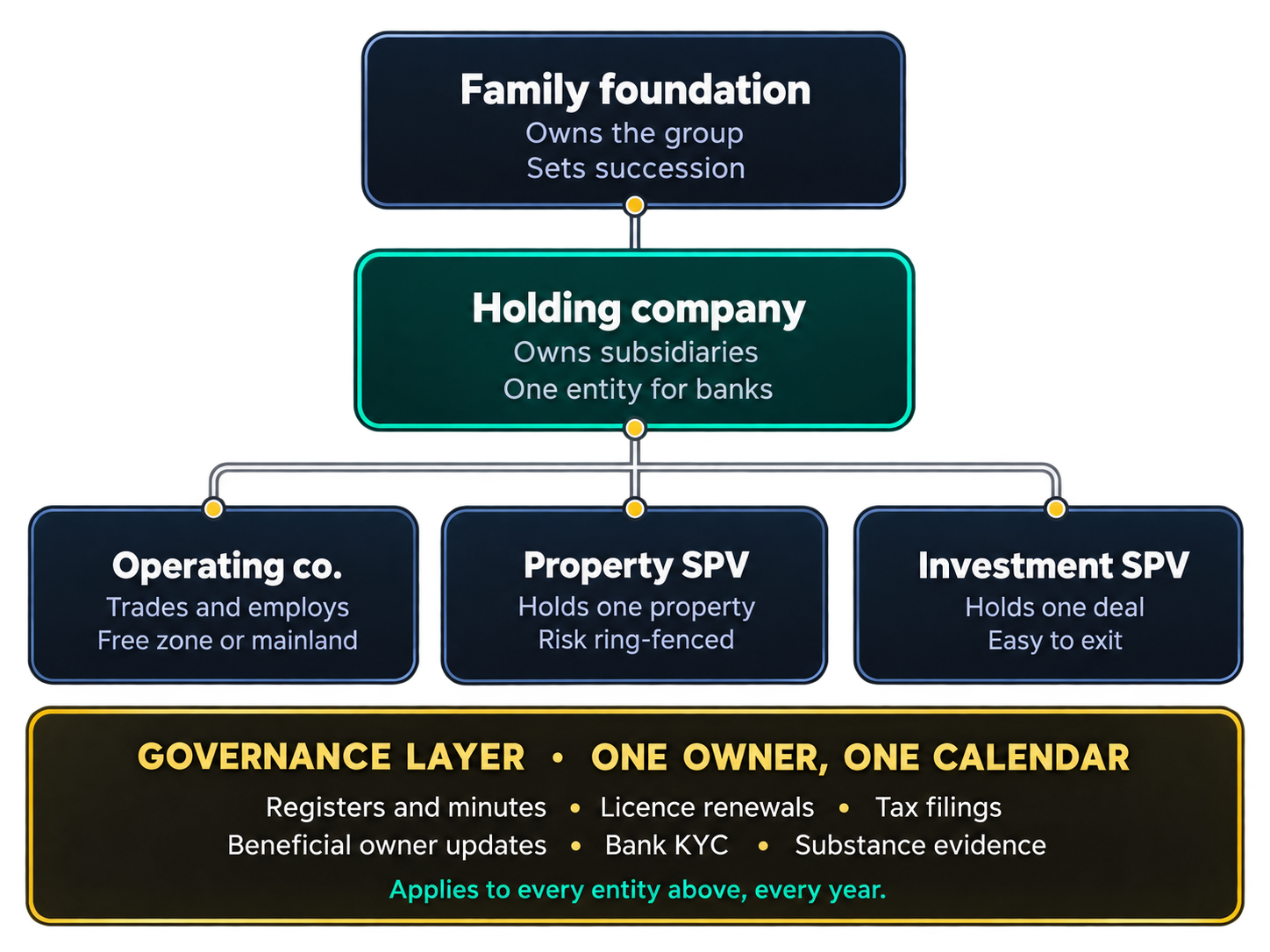
- Map every entity, its authority and its purpose on one page
- Confirm your corporate tax registration and filings with the Federal Tax Authority
Sources & references
UAE legislation and professional legal commentary.
Official sources(2)
Federal Decree-Law No. 32 of 2021
UAE Commercial Companies Law, as amended by Federal Decree-Law No. 20 of 2025, published in Federal Gazette No. 809 on 14 October 2025.
UAE Ministry of Economy and Tourism
Review of Commercial Companies Law amendments, published on 6 January 2026.
Law firm commentary(5)
- Baker McKenzie
Recent amendments to the Commercial Companies Law
- Gibson Dunn
Recent amendments to the UAE Commercial Companies Law
- Cleary Gottlieb
UAE Companies Law Update 2025
- Clyde & Co
UAE Companies Law amendments 2025
- Galadari
Federal Decree-Law No. 20 of 2025 key points
Note: Regulations and implementing guidance may change. Verify current requirements and seek independent legal advice.